
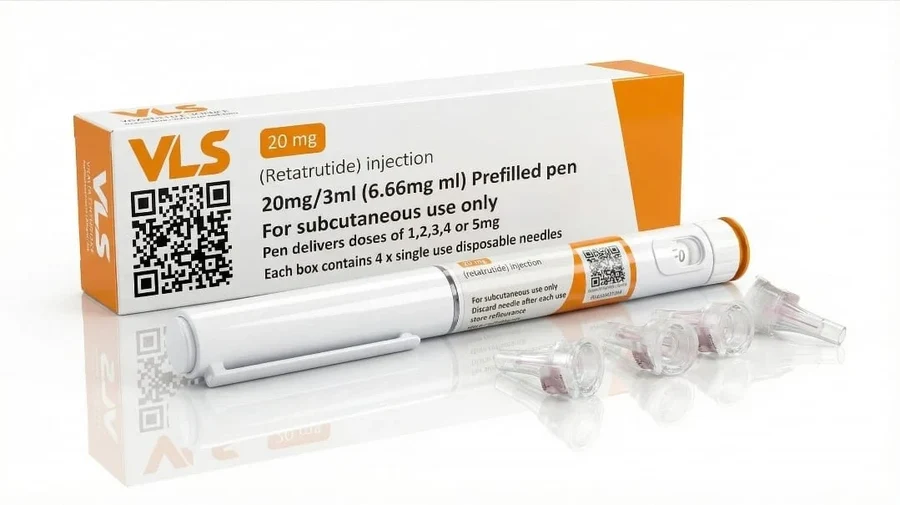
VLS Retatrutide 20mg Pen: Research-Grade Triple Agonist Peptide for Laboratory Use
Few compounds have drawn as much attention from the metabolic research community as retatrutide. It is a synthetic peptide that acts on three receptors at once, GIP, GLP-1 and glucagon, and that unusual profile has made it a focal point for in vitro and preclinical studies. The VLS Retatrutide 20mg Pen presents this compound in a pen format for researchers who want well-documented, consistently labelled material.
In this guide you will learn what the product is, how retatrutide works at the receptor level, how it compares with tirzepatide and semaglutide in the scientific literature, how to receive and document research material properly, and what to check before you buy. We have kept the language factual on purpose.
What Is VLS Retatrutide 20mg Pen?
VLS Retatrutide 20mg Pen is a research-grade retatrutide peptide supplied in pen format for laboratory use only. Retatrutide is an investigational triple agonist that targets the GIP, GLP-1 and glucagon receptors. The product is not FDA-approved and is not intended for human or animal consumption.
VLS Retatrutide 20mg Pen at a Glance
| Specification | Detail |
| Product name | VLS Retatrutide 20mg Pen |
| Compound | Retatrutide (development code LY3437943), synthetic peptide |
| Labelled quantity | 20 mg per pen, as stated on the product label |
| Format | Pen-format presentation for laboratory handling |
| Mechanism studied | Combined GIP, GLP-1 and glucagon receptor agonism |
| Intended use | Laboratory and preclinical research only |
| Regulatory status | Investigational compound; not FDA-approved |
| Not intended for | Human or animal consumption, diagnosis, treatment or prevention |
Understanding Retatrutide: Why Researchers Call It a Triple Agonist
Most incretin-based compounds studied over the past two decades hit one or two targets. Retatrutide is different because a single molecule engages three. That is why it keeps appearing in metabolic research papers, conference posters and grant proposals.
The three receptors involved
- GLP-1 receptor. The GLP-1 receptor is the target of the best-known incretin mimetics and is studied for its role in glucose-dependent insulin signalling and satiety pathways.
- GIP receptor. The GIP receptor responds to glucose-dependent insulinotropic polypeptide, a gut hormone that interacts with GLP-1 signalling in complex ways researchers are still mapping.
- Glucagon receptor. The glucagon receptor is typically associated with hepatic glucose output and energy expenditure, which makes its inclusion in a combined agonist scientifically interesting.
Why a three-receptor profile matters in the lab
Studying receptors in isolation only tells part of the story. A triple agonist gives investigators a single tool for examining how overlapping hormone pathways interact, for example in cell-based receptor assays, signalling studies and animal models of energy balance. The retatrutide entry on Wikipedia offers a useful overview of the compound and its development history.
Why a Pen Format for Research Material?
Researchers care about two things when handling peptides: consistency and traceability. A pen-format presentation supports both by keeping the labelled material in a single, clearly identified unit.
- Clear identification. One labelled unit per pen makes it easier to match material to a batch record in your lab notebook.
- Reduced handling. Fewer transfers between containers means fewer opportunities for contamination or labelling mistakes.
- Easy inventory control. A fixed labelled quantity of 20 mg per pen simplifies stock counts and audit trails.
The 20 mg figure describes the labelled peptide quantity in the product. It is a cataloguing detail, not a dosing instruction, and nothing on this page should be read as guidance for use in people or animals.
What the Published Research Says About Retatrutide
Because retatrutide has attracted so much attention, it is worth separating the published science from marketing noise. The facts below describe the investigational drug developed by Eli Lilly. They do not describe or support any claim about this product.
Phase 2 findings
The compound was described in a Phase 2 trial published in the New England Journal of Medicine in 2023. Lilly reports that the study showed substantial mean weight reduction at 24 weeks in adults with obesity or overweight, which prompted the move to a large Phase 3 programme.
The Phase 3 programme
Lilly has since reported topline results from several Phase 3 studies in its TRIUMPH and TRANSCEND programmes, including trials in obesity, type 2 diabetes and cardiovascular disease. You can review trial registrations on ClinicalTrials.gov and the sponsor overview on Lilly’s retatrutide page.
Where regulatory approval stands
Retatrutide is still an investigational medicine. As of mid-2026, Lilly has said it plans to submit a Biologics License Application to the U.S. Food and Drug Administration in the first quarter of 2027. A planned filing is not an approval, and timelines can change. Until a regulator approves a product, it cannot be marketed for human use.
Retatrutide vs Tirzepatide vs Semaglutide: Research Comparison
Researchers often ask how retatrutide differs from the compounds that came before it. This table compares receptor targets only, as described in the literature.
| Feature | Retatrutide | Tirzepatide | Semaglutide |
| Receptor targets | GIP, GLP-1, glucagon | GIP, GLP-1 | GLP-1 |
| Number of targets | Three | Two | One |
| Regulatory status | Investigational | Approved products exist | Approved products exist |
| Typical research interest | Multi-pathway receptor signalling | Dual incretin signalling | Single-pathway GLP-1 signalling |
The practical takeaway for a lab is simple. If your question is about how glucagon receptor activity changes the picture on top of GIP and GLP-1 activity, a triple agonist is the relevant tool. If you only need GLP-1 signalling, a simpler compound may suit your design better.
Common Laboratory Applications for Retatrutide
Retatrutide is studied wherever investigators want to understand how several hormone pathways work together. The examples below are typical of the published literature and are listed to help you plan experiments, not to suggest any use outside the lab.
In vitro receptor assays
Cell lines expressing the GIP, GLP-1 or glucagon receptor are used to measure binding, cyclic AMP signalling and receptor desensitisation. A triple agonist lets a group compare responses across all three targets with one reference compound.
Signalling and pathway studies
Researchers examine downstream signalling to see where the three pathways reinforce or offset each other. Clear lot records matter here, because small differences in material can change how reproducible a signalling readout is.
Preclinical models of energy balance
Approved animal research programmes use incretin and glucagon agonists to study food intake, glucose handling and energy expenditure. Any work like this needs institutional ethics approval and a written protocol before material is used.
Pros and Cons for Research Procurement
| Advantages | Considerations |
| Single compound covers three receptor targets | Investigational molecule with an evolving literature |
| Pen format keeps material clearly labelled and traceable | Strictly for laboratory use; no human or animal use |
| Fixed labelled quantity simplifies inventory records | Peptides are sensitive to storage conditions |
| Large and growing body of published research to cite | Not a substitute for approved medicines |
Step-by-Step: Receiving and Documenting Research Material
Good record keeping protects your data. Here is a simple routine many research groups follow when new peptide material arrives.
- Inspect the package on arrival. Check that the outer packaging is intact and that the pen label matches your order.
- Record the details. Note the product name, labelled quantity, batch or lot reference and date received in your lab notebook.
- Store as directed. Follow the storage instructions printed on the label and keep the material away from heat and direct light.
- Restrict access. Keep research compounds in a labelled, controlled area and limit access to trained personnel.
- Log every use. Record when and how material is used within your approved protocol so results stay reproducible.
- Dispose responsibly. Follow your institution’s chemical and biological waste procedures.
What to Look for in a Research Peptide Supplier
Not every supplier meets the same standard, and a low price is a poor guide to quality. Before you order any research peptide, check these points.
- Batch documentation. A credible supplier can tell you which batch you are receiving and should be able to answer questions about it.
- Clear labelling. Compound name, quantity and research-use-only wording should appear on the product.
- Honest claims. Be wary of any seller who makes health or weight-loss promises. Those claims are a red flag for unapproved products.
- Transparent policies. Shipping, returns and compliance terms should be easy to find before you pay.
Purity, Testing and Why Documentation Matters
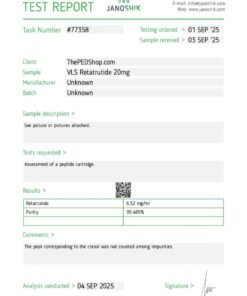
Peptide quality is usually confirmed with analytical methods such as high-performance liquid chromatography, which separates a sample into its components, and mass spectrometry, which confirms molecular identity. Together they show whether the peptide you hold is the peptide you intended to study.
When you evaluate any supplier, ask which methods were used and how results are linked to a specific batch. Do not rely on a purity figure that cannot be tied to a lot number. For regulated or publication-grade work, keep a copy of the batch record alongside your raw data.
Storage and Handling Best Practices
Peptides are delicate molecules. Heat, repeated temperature changes, moisture and light can all reduce stability and make results harder to reproduce.
- Read and follow the storage instructions printed on the product label.
- Avoid leaving material at room temperature for longer than your protocol allows.
- Keep the pen in its original packaging until it is needed.
- Label every secondary container with the compound name, date and batch reference.
- Never share or repackage material outside your approved research team.
Regulatory Status and Responsible Use
Retatrutide is an investigational compound. This product is sold for in vitro and preclinical research, and by purchasing it you confirm that you are a qualified researcher who will use it in line with applicable laws and your institution’s policies. If you want to understand how drug regulation works, the FDA and, in the UK, the MHRA publish clear guidance for the public.
Anyone seeking treatment for weight or metabolic conditions should speak to a licensed healthcare professional about approved options. Research compounds are not an alternative.
Who Is This Product For?
- Academic and commercial laboratories running receptor, signalling or cell-based assays.
- Preclinical research groups studying incretin and glucagon pathways.
- Analytical teams that need clearly labelled reference material.
It is not for personal use, cosmetic use or any form of self-experimentation.
Frequently Asked Questions About VLS Retatrutide 20mg Pen
What is VLS Retatrutide 20mg Pen used for?
It is supplied for laboratory research only, such as receptor-binding and signalling studies of the GIP, GLP-1 and glucagon pathways. It is not for human or animal use.
Is retatrutide FDA-approved?
No. Retatrutide is an investigational medicine, and Lilly has said it plans to file for FDA review in early 2027. This product is not an approved drug.
What does 20mg mean on the pen?
It is the labelled peptide quantity in the product. It is a cataloguing figure and not a dosing recommendation.
How is retatrutide different from tirzepatide?
Tirzepatide activates two receptors, GIP and GLP-1. Retatrutide adds glucagon receptor activity, making it a triple agonist.
How should research peptides be stored?
Follow the storage instructions on the product label. In general, peptides are sensitive to heat, light and moisture, so keep them in a controlled environment.
Can I use this product on myself?
No. This product is not a medicine and must not be used by people or animals. Speak to a licensed healthcare professional about approved treatments.
Final Thoughts: Is VLS Retatrutide 20mg Pen Right for Your Lab?
If your work involves multi-receptor incretin and glucagon signalling, the VLS Retatrutide 20mg Pen gives you a clearly labelled, pen-format unit to build your protocols around. Read the label, record the batch, store the material correctly and keep every use within an approved research setting.
Whatever your project, treat this peptide as you would any other investigational research material: with clear records, secure storage and a firm line between laboratory work and personal use. That discipline is what makes your data credible and your lab compliant.
Ready to order? Add the VLS Retatrutide 20mg Pen to your cart today, strictly for research use only.
5 reviews for VLS Retatrutide 20mg Pen.
Add a review
Related products
Peptides Health & Wellness
VLS WEIGHT LOSS
VLS WEIGHT LOSS

Isaiah Perry –
Compact pen size and very straightforward to use. Excellent addition to the lab inventory.
Penelope Long –
Reliable delivery and good product integrity. Packaging was secure and neat.
Aaron Butler –
Clean packaging and accurate dosage capabilities. Works wonderfully for our trials.
Leah Sanders –
Excellent laboratory tool. Functions smoothly without any mechanical issues.
Christian Price –
High standard of quality control. Very satisfied with the overall experience.